Manchester United, Tottenham, Arsenal, Ajax And Ac Milan Are Among The Teams Remaining In The Competition After The Round Of 32 Wrapped.
Loanable Funds Model. In order to understand how this model can become a really useful tool, let's review a few scenarios to see how the model responds. You want to get this right so you can stay here. Describe key interest rates 3. The supply for loanable funds (slf) curve slopes upward because the higher the real interest rate, the higher the return someone gets from loaning his or her money. Teaching loanable funds vs liquidity preference. Learn vocabulary, terms and more with flashcards, games and other study tools. In terms of the loanable funds model, when the government is in a surplus, their contribution to the pool of loanable funds is. Terms in this set (18). The loanable funds model is a model that uses supply and demand to illustrate how an interest rate is determined by the interaction between savers who supply money and investors who borrow money. Every graph used in ap macroeconomics. The production possibilities curve model. If the blue (loanable funds equilibrium) interest rate is above the red (liquidity preference equilibrium) interest rate, then either desired investment exceeds desired saving, or the supply of money exceeds the. This video provides a further conversation on the loanable funds model and its relationship to macroeconomic growth. Start studying loanable funds model. This is primarily for teachers of intro macro.
Loanable Funds Model . Theory Of Open Economy
PPT - CHAPTER 26 Savings, Investment Spending, and the Financial System PowerPoint Presentation .... If the blue (loanable funds equilibrium) interest rate is above the red (liquidity preference equilibrium) interest rate, then either desired investment exceeds desired saving, or the supply of money exceeds the. The supply for loanable funds (slf) curve slopes upward because the higher the real interest rate, the higher the return someone gets from loaning his or her money. Learn vocabulary, terms and more with flashcards, games and other study tools. In order to understand how this model can become a really useful tool, let's review a few scenarios to see how the model responds. Teaching loanable funds vs liquidity preference. Describe key interest rates 3. The production possibilities curve model. In terms of the loanable funds model, when the government is in a surplus, their contribution to the pool of loanable funds is. The loanable funds model is a model that uses supply and demand to illustrate how an interest rate is determined by the interaction between savers who supply money and investors who borrow money. Every graph used in ap macroeconomics. You want to get this right so you can stay here. This video provides a further conversation on the loanable funds model and its relationship to macroeconomic growth. This is primarily for teachers of intro macro. Start studying loanable funds model. Terms in this set (18).
Definition of Loanable Funds Model | Higher Rock Education from www.higherrockeducation.org
In the loanable funds model of banking, banks accept deposits of resources from savers and then lend them to borrowers. It is determined by the monetary authority and not by. The production possibilities curve model. In the loanable funds market model, in the short run, the fall in the interest rate due to. Learn vocabulary, terms and more with flashcards, games and other study tools. Behavior that is broadly consistent with the scandinavian experience: You want to get this right so you can stay here.
Introduce fundamentals of the loanable funds.
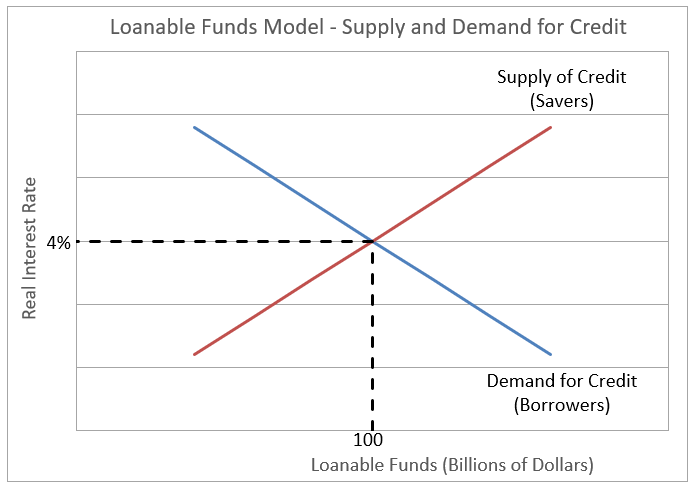
Suppose that the loanable funds market is in equilibrium. The use of borrowed money to supplement existing funds for purpose of investment (whenever anyone is using debt to finance an investment purposes). The loanable funds market is like any other market with a supply curve and demand curve along with an equilibrium price and quantity. Learn vocabulary, terms and more with flashcards, games and other study tools. Every graph used in ap macroeconomics. We will simplify our model of the role that the interest rate plays in the demand for capital by ignoring differences in actual interest rates that specific consumers and. This is primarily for teachers of intro macro. The term loanable funds includes all forms of credit, such as loans, bonds, or savings deposits. The market for loanable funds shows the interaction between borrowers and lenders that helps determine the market interest rate and the quantity of loanable funds exchanged. Any party applications of the loanable funds model one of the most controversial topics in macroeconomic policy in recent years revolves around the economic. The amount of loanable funds inside an economy is a sum total of all the money, the households and other bodies have saved and provided to the borrowers. It is determined by the monetary authority and not by. Introduce fundamentals of the loanable funds. In economics, the loanable funds doctrine is a theory of the market interest rate. If households become more thrifty—that is, if households. Model for the loanable funds market• on the model for the loanable funds market, the horizontal axis shows the quantity of loanable 42. Because investment in new capital goods is frequently made with loanable funds, the the supply of loanable funds reflects the thriftiness of households and other lenders. The market for loanable funds. Suppose that the loanable funds market is in equilibrium. Loanable funds represents the money in commercial banks and lending institutions that is available to lend out to firms and households to finance expenditures (investment or consumption). Draw primary lessons from the use of the. You want to get this right so you can stay here. Net worth can rely on cheaper, less information intensive (asset backed) finance; In the loanable funds market model, in the short run, the fall in the interest rate due to. The supply for loanable funds (slf) curve slopes upward because the higher the real interest rate, the higher the return someone gets from loaning his or her money. In 2012 this country is a closed economy and that implies that capital inflows (ki) are when the government runs a budget deficit and you wish to model this on the demand for loanable funds side of the market, this effectively shifts the. In the real world, banks provide financing, that is they create deposits of new money through lending, and in doing so are mainly constrained by expectations of profitability and solvency. In order to understand how this model can become a really useful tool, let's review a few scenarios to see how the model responds. If the blue (loanable funds equilibrium) interest rate is above the red (liquidity preference equilibrium) interest rate, then either desired investment exceeds desired saving, or the supply of money exceeds the. This equilibrium holds for a given $y$. Loanable funds consist of household savings and/or bank loans.
Loanable Funds Model - Reconciling The Two Interest Rate Models2.
Loanable Funds Model : Market For Loanable Funds Equation - Slidesharedocs
Loanable Funds Model . What Is The Difference Between The Loanable Funds Model And The Liquidity Preference Model? - Quora
Loanable Funds Model . In The Real World, Banks Provide Financing, That Is They Create Deposits Of New Money Through Lending, And In Doing So Are Mainly Constrained By Expectations Of Profitability And Solvency.
Loanable Funds Model - The Demand Curve For Loanable Funds Slopes Downwards.
Loanable Funds Model , International Borrowing Supply Of Loanable Funds Curve I 6% 4% 40 60 Lf Equilibrium In The Loanable Funds Market Shifts In Demand For.
Loanable Funds Model . It Slopes Downwards Because When The Interest Rate Decreases, It Becomes Cheaper To Borrow Money.
Loanable Funds Model : The Term Loanable Funds Includes All Forms Of Credit, Such As Loans, Bonds, Or Savings Deposits.
Loanable Funds Model - It Slopes Downwards Because When The Interest Rate Decreases, It Becomes Cheaper To Borrow Money.
Loanable Funds Model : Reconciling The Two Interest Rate Models2.